

The Big Apple hosted its annual pre-Easter automotive event at the Jacob Javits Center. Not every automaker showed up. Honda was the most surprising absentee, but there was enough news to justify the trip to New York. Rumors and discussions hinted at a return of the sedan in the U.S. However, this show was most definitely about SUVs. To borrow a phrase from former General Motors CEO Alfred Sloan, this year’s show offered an SUV for every purse and purpose.
SUVs for Outdoor Enthusiasts

Hyundai’s cleverly named Boulder concept emerged as the undisputed star of the New York International Auto Show (NYIAS) . There was anticipation around its reveal. Hyundai flew media out to New York for the debut, opting for an “old school” approach; they provided no advance material and told journalists they’d see the truck at the same time as everyone else. Hyundai has confirmed plans to bring a midsize, body-on-frame truck to the U.S. by 2030.
The Boulder offered a glimpse into how the brand would apply its “art of steel” design language to an off-road vehicle. The look is decidedly Bronco-esque—more so than the Crater SUV concept shown in Los Angeles last fall. It features short overhangs designed to minimize approach and departure angles. The rear doors are coach-style, and the absence of a B-pillar makes ingress and egress easy. Out back, the swing-out tailgate opens to the left or right. Although Hyundai did not commit to this concept, it is likely conducting market research to gauge interest. A production model inspired by this concept would not be surprising.
The NYIAS website trumpeted Toyota’s new electric Highlander, but that vehicle was not on display. Nearby, however, was the Highlander’s new sibling, unveiled by partner Subaru: the new Getaway.

The Getaway is Subaru’s fourth EV, joining the Toyota-sourced Uncharted, Solterra, and Trailseeker. It appears to offer the same level of differentiation. Unlike those vehicles, it’s not based on a dedicated EV platform. Instead, it uses Toyota’s midsize GA-K architecture, which also underpins the Toyota Camry and Grand Highlander.
The Getaway is just a bit longer, lower, and wider than the internal-combustion-powered Ascent. It has a 6-inch-longer wheelbase. The dual-motor AWD setup boasts an impressive 420 horsepower—the most powerful Subaru ever. That’s 32 horsepower more than the Highlander and kicks the Getaway to 60 mph in under five seconds. The 96 kWh battery offers about 300 miles of range.
Subaru notes that a smaller battery and a lower price point will be available next year. Unfortunately, the 400V electrical architecture means the 150 kW DC fast charge rate will be slower than Kia’s EV9 or Hyundai’s Ioniq 9. However, the Getaway’s 8.3 inches of ground clearance gives a bit more off-road capability.
The interior is more conventional than the Solterra. It features a 14-inch touchscreen, a 12.3-inch digital instrument cluster, and a refreshingly normal round steering wheel. Overall, it looks like a competitive package that offers buyers something Honda, Nissan, and Ford don’t—at least not yet.
Family Haulers

Moving along to options for the head of the household, it’s been nine years since VW launched the Atlas. This vehicle was specifically designed for America’s “we love ‘em big” family SUV market. The long-overdue update appears identical to the China-market Teramont Pro. That’s not a bad thing. The new Atlas is a bit bigger but looks more sophisticated. It has sleeker surfacing and a front light bar featuring a large illuminated logo.
The interior, which now offers a rich “dark wine” color option, features real wood trim and Nappa leather upholstery. A new 14-inch touchscreen is front and center. The 2.0-liter turbo engine has been tweaked to put out 282 horsepower. VW promises a hybrid (not a plug-in) when the model gets a midcycle update, likely in about three years. Not discussed was the Atlas Cross Sport, the two-row, sportier sibling. It accounted for about 30 percent of Atlas sales last year. That vehicle is likely to get a next-generation model in a couple of years.
Enthusiast EVs

For those drawn to electric vehicles, Kia’s EV3 is finally making its way to U.S. shores this fall. It was unveiled as a concept in 2023 and has been on sale overseas for the past two years. Looking like a pint-size EV9, it’s a very distinctive design. It features “star map” running lights, up to 19-inch wheels, and a sloping roofline to help aerodynamics. It uses the lower-cost 400V architecture shared with the EV4 compact sedan and the upcoming Hyundai Ioniq 3. The 10-80% charge time is about 30 minutes.
There’s a lot of choice here: two battery sizes, three power outputs, and either front- or all-wheel drive. The top-line GT offers an impressive 288 horsepower. The bigger battery targets an enviable EV range of 320 miles; the smaller battery is likely to be closer to 200. Although it competes with other entry-level EVs like the Nissan Leaf and Chevy Bolt, it offers high-end equipment. Features include a head-up display, a surround-view monitor, and an extensive standard suite of driver-assist technology.
Kia’s innovative i-Pedal 3.0 technology enables one-pedal driving is standard. Optional V2L capability lets you plug in a TV, an electric grill, or whatever needs some juice. The big unanswered question is price, but most estimates suggest a starting price in the low 30s. That’s just a bit higher than where the Bolt and Leaf start. It’s been selling well in Europe and is definitely a compelling alternative for those seeking an affordable EV.
Smart Values

Turning to choices for budget-conscious buyers, Kia also brought the 2nd-generation Seltos to New York. Just as the EV3 draws inspiration from the EV9, the Seltos draws on the Telluride flagship for a unique look. The vertical amber running lights up front create a distinctive face.
The industry’s return to color means you can get your Seltos in Terrain Brown or Frost Blue, among other choices. The Seltos is longer, wider, and roomier. It features new multi-terrain AWD technology and up to 8.1 inches of ground clearance. The 2.0-liter L4 and 1.6-liter turbo engines are carried over. Kia will add a new hybrid option next year.
Like the EV3, the Seltos offers unexpected upscale content. This includes a panoramic sunroof and a power driver’s seat with memory. It shares a similar interior design with the EV3 and offers twin 12.3-inch displays. The cargo area features a height-adjustable and multi-folding luggage board. Current Seltos sales jumped 30 percent for the first quarter of this year versus 2025. This new and improved model should do even better when it launches later this year.
Design Driven

Next, for style-focused buyers, most people were skeptical when BMW launched its first X6, a “sport activity coupe” SUV that put form over function with a sloping roofline. But that didn’t stop Mercedes, Porsche, Audi, and Genesis from following suit. Now, Infiniti joins the playing field with the QX65—a sleeker variant of the three-row QX60, featuring a faster roofline, swooping chrome trim, and more distinctive taillamps.
All that panache comes with a higher price tag, about $55,000. Its 268-horsepower turbocharged L4 seems a bit underwhelming compared with the competition. However, there are rumors of both a V6 and a Red Sport performance variant in the works, which might be worth waiting for. Meanwhile, Infiniti is slowly reworking its portfolio: a new Q50 sedan (with a manual transmission) and a Rogue-based QX50 SUV are due over the next two years. For dealers, those new models can’t come soon enough.
Muscle Machines

Moving on to performance fans, you might be surprised to hear the current Dodge Durango is 15 years old. You’d be even more surprised to hear that last year was the best sales year for Durango in 20 years. Dodge chalks that up to the unique “muscle” positioning of their SUV. The recently launched Hemi-powered Durango R/T 392 offers the most horsepower of any SUV under $50,000. New York saw the arrival of an America250 variant, complete with stars-and-stripes graphics, but not much else. Given the Durango’s strong sales, why mess with a good thing?
SUV Substitutes
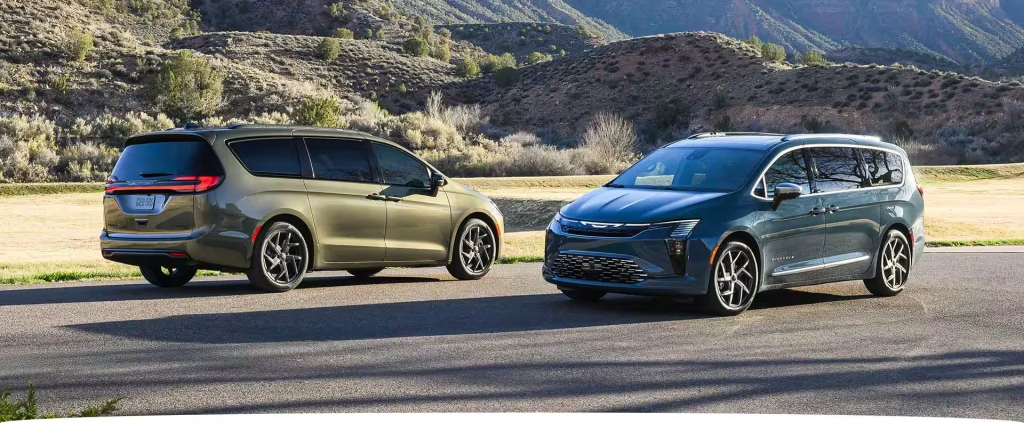
For those seeking alternatives to SUVs, there were a few noteworthy people-moving and cargo-carrying vehicles in New York:
- The Chrysler Pacifica got a new, more modern face. Unfortunately, not much else changed. The plug-in hybrid is gone. That leaves Kia and Toyota as the only brands to offer an electrified minivan. The interior only received a few trim upgrades. With minivan sales in the U.S. up 20% last year, Chrysler hopes this refresh will keep the Pacifica competitive until the next generation arrives in two years. Still, it may be an uphill struggle.
- Ram’s new Promaster City is still “entry level” but is no longer compact. It’s based on Stellantis’ European midsize van and is built in Turkey. It’s powered by a 1.6-liter turbo L4. Both cargo and passenger variants are available, with a payload capacity of up to 2,000 pounds. American business owners apparently didn’t like compact vans like the last-generation model or the similar Nissan NV200 and Ford Transit Connect. This new model gives Ram something you can’t get from GM, Ford, or Mercedes.
- Genesis brought their G90 Wingback wagon concept to the show to celebrate its 10th anniversary. It is not officially scheduled for production, but Genesis hinted at the possibility. The brand promised 22 new or updated U.S. models by 2030.

Final Word
The NYIAS didn’t offer the full snapshot of the industry it once did, but there was enough new hardware to hold your attention, and evidence that automakers are continuing to explore new opportunities to attract buyers.
Discover more from Driving the Backroads
Subscribe to get the latest posts sent to your email.
