

Amid rumors Chinese auto makers are planning to sell EVs in the U.S., Europeans are poised to beat them to market.
In a February interview with Yahoo Finance, BYD executive VP and CEO of BYD Americas, Stella Li, confirmed the powerful automaker has no plans to sell passenger EVs in the American market. Li cited conflicting politics and stated the U.S. market is “interesting” but “It’s too complicated.”
While Chinese automakers are determining how and when to enter the U.S. market, two European brands are moving forward with plans to launch in the U.S. by the end of the decade.
THE PLAYERS
Alpine is part of the Renault Group and the larger Renault-Nissan-Mitsubishi alliance. The original Alpine brand extended from 1954 to 1995, adorning a lightweight two-seat sports car and an upmarket 2+2. Leveraging a strong presence in motorsports post-1995, it became a performance trim level for parent company Renault.

In 2017, the Alpine brand was relaunched with a new A110 sports car. Six years later, Renault announced plans to reboot the brand as an all-electric, high-performance automaker. According to its “Future Tour” presentation from June 2023, Alpine is positioning itself as a “passion-driven” brand positioned between traditional premium and luxury automakers.
Cupra is also part of a larger empire, the sprawling 14-brand Volkswagen Group. It began as the performance sub-brand for the Spain-based SEAT brand, which VW Group took control of in 1986. The Cupra name first appeared 10 years later on the Ibiza small hatchback and soon propagated across the SEAT portfolio.
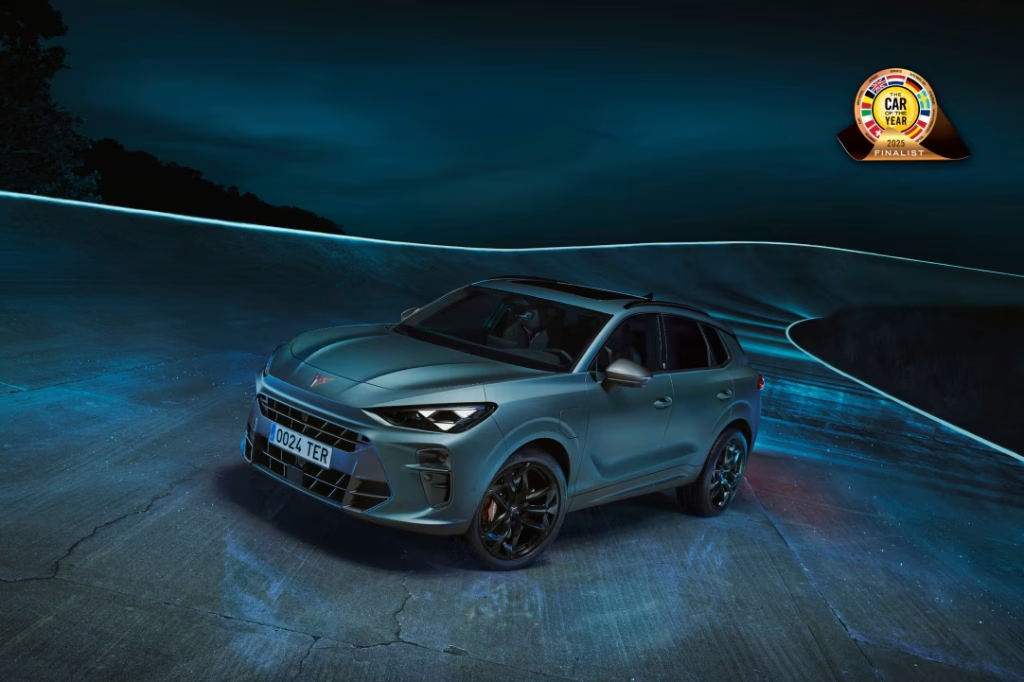
Cupra was launched as a stand-alone brand in 2018. Its brand position is not as premium as Alpine’s, but Cupra says the brand “stands as the pinnacle of powerful innovation and engineering brilliance.”
THE PLANS
Part of Alpine’s “Future Tour” presentation included plans to launch in America in 2027. Sales and distribution strategies have not been detailed but there’s no Renault dealer network in the U.S. A direct sales model like Tesla or Rivian might be used. Alpines are currently built in Europe, so there may be a risk of tariffs, depending upon what the Trump administration initiates.
The current Alpine portfolio includes:
A290: a high-performance small hatchback based on the new electric Renault 5, essentially a French counterpart to the Mini Cooper;
A390: a compact SUV coupé comparable to the new Mini Countryman;
A110: a lightweight two-seater whose replacement, due in 2026, will be electric instead of internal combustion.

Only the A390 and A110 are potential U.S.-bound entries since Americans aren’t particularly fond of small cars like the A290.
Alpine has also indicated plans for a larger performance-oriented SUV (A490) and A310 (2+2 coupé). Both vehicles could sell well in the U.S. Alpine has also indicated it’s working on a new architecture for its electric sports cars, although the platform is unknown.
Cupra’s portfolio includes the compact internal-combustion Leon and electric Born hatchbacks, and a quartet of small and compact SUVs. Cupra’s plan is to launch in the U.S. with an electric version of the next-generation Formentor compact SUV and a new large, still-to-be-announced electric SUV.
Cupra’s portfolio would leverage existing and upcoming VW Group architectures. Like Alpine, the original plan was to be an electric-only brand. But in November, Motor Authority reported Cupra will now be in the U.S. with a broader portfolio of electric and hybrid entries.

Even though Cupra’s launch is about three years later than Alpine, it’s already reached out to Penske to arrange a sales and distribution network. Finally, Cupra’s vehicles could be built in existing VW plants in North America. It would allow the carmaker to circumvent pending new tariffs on imported vehicles, depending on the pending tariff plans of the Trump administration.
WILL IT WORK?
Alpine has a tougher challenge in a shorter time frame. It’s currently an electric-only brand. Its architectural strategy is less defined. The new sports car platform doesn’t exist and is likely to face some engineering challenges, while the larger SUV doesn’t seem to have a platform yet.
Renault has no existing dealer network in North America to leverage. Utilizing the direct-sales route may result in legal challenges from traditional dealers. There’s just no clear way to build these vehicles in North America.

Cupra is in slightly better shape. The availability of both electric and internal combustion power offers some flexibility as the market evolves. Building Cupras in VW Group plants in North America avoids the tariff issue.
Leveraging a known entity like Penske will help address the sales and distribution question. But but if Cupra sidesteps dealers like VW Group’s new Scout brand is planning, VW of America may face similar lawsuits from dealers and the National Auto Dealer Association.
WHO SHOULD CARE?
Alpine and Cupra will likely come in priced above mainstream players like Ford, Chevrolet, Toyota and Hyundai. Premium and tier-two luxury brands like Acura, Buick, Genesis and Volvo are likely primary targets. But unlike traditional startups, these brands will have more corporate-sourced resources to support launches.

Neither Cupra nor Alpine is expected to be a huge volume player, but there is still the potential to attract buyers from legacy brands.
THE BOTTOM LINE
While Alpine has to determine what to do more quickly, both brands could bring new, interesting choices to U.S. buyers.
Discover more from Driving the Backroads
Subscribe to get the latest posts sent to your email.
